Folsom, CA · Garage Door Service
Fixing vs. Replacing: What Makes Sense for Folsom's Older Garage Doors
Folsom homes built between 1962 and 2004 often have original garage door hardware. Here's how to tell when repair still makes sense and when it doesn't.
- Repairs & new doors
- Springs & openers
- Serving 8 nearby communities
The Problem
Folsom's housing stock mostly went up between 1962 and 2004, with the median build year sitting around 1981, which means a lot of original torsion springs and openers are now pushing forty years old. A spring rated for ten thousand cycles doesn't know what decade it is, but it does know how many times it's been wound and released, and a door installed when a house was built in the early 1980s has been through a lot of winters and a lot of summers by now. The call we get most from these houses isn't "my door broke," it's "my door is getting loud" or "it's starting to hang a little crooked on one side." Those are wear signs, not failure, and they don't always mean the whole unit needs to come out. What they do mean is the hardware is old enough that waiting costs more than looking. A cable that frays on a thirty-year-old drum setup doesn't give much warning before it lets go, and when it does, it usually takes a panel or a finger with it. Across this part of the region, where most of the 28 named communities share that same 1980s-to-90s construction wave, this is less an edge case than the normal state of things.
What Most People Get Wrong
The mistake we see most is treating the door as one unit instead of a collection of parts with different lifespans. A steel door from 1985 with a bent track and a worn roller isn't a door that needs replacing - it's a door that needs a track and rollers. Springs, cables, rollers, and openers wear out on their own schedules, usually well before the door panel itself gives out, so a full replacement is often money spent on parts that were fine. With a median household income of $97,972 across 169,115 households in this service area, many Folsom owners can absorb a repair bill without much trouble but would rather not eat the cost of a full replacement if they don't have to, which is exactly the math that should drive the decision. The other mistake runs the opposite direction: patching a door with a rusted-through bottom panel or a warped wood face because the opener still runs fine. The opener isn't the problem in that case. If the structural panel is failing, no amount of spring or roller work fixes that, and we'll tell you so rather than keep billing for patches that won't hold.
The Seasonal Bit
Folsom sits in a moderate-heat climate band, not a freeze-thaw one, so the failure pattern here looks different than it would somewhere with hard winters. You're not dealing with ice splitting a seal or a motor straining to turn over cold grease. What you're dealing with is the opposite problem, repeated and gradual: heat drying out lubricant on tracks and hinges faster than owners expect, and metal hardware expanding and contracting through hot days and cooler nights for years on end. On a door built in the early 1980s, that's four decades of thermal cycling on springs and fasteners that were torqued once and never touched again. We tend to see a jump in spring failures and opener strain calls as the weather swings into the hottest stretch, not because the heat itself breaks anything outright, but because it accelerates wear that was already sitting on borrowed time. If your door hasn't been lubricated in longer than you can remember, that's the first thing worth fixing before anything else, and it costs a fraction of a service call.
What the Weather Here Does to It
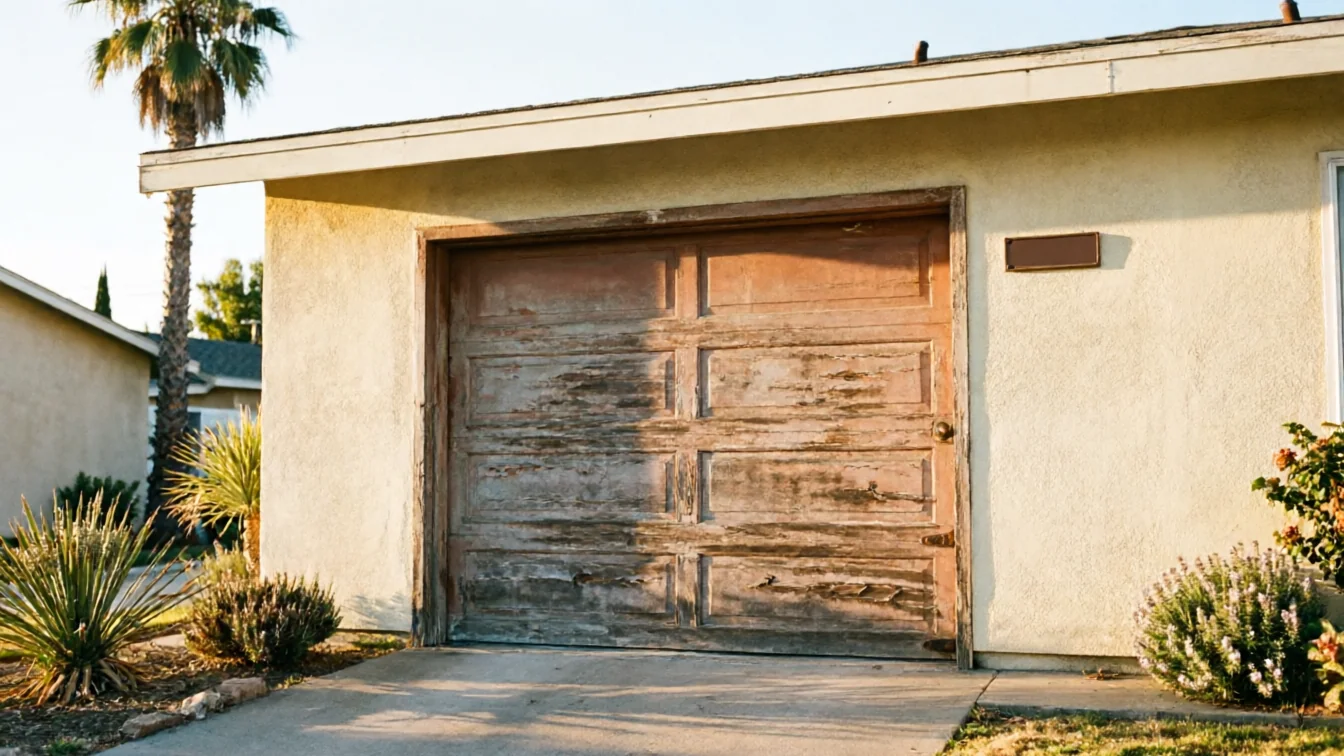
Heat doesn't announce itself the way cold does. A door doesn't freeze shut in Folsom, but UV exposure and sustained summer heat do quieter damage over time: weatherstripping hardens and cracks instead of staying pliable, wood-faced doors can warp or check on the sun-facing side, and the lubricant on tracks and hinges breaks down faster than the manufacturer's service interval assumes. On a house from the 1980s or 90s median era that this area is built on, that's decades of heat cycling on original seals and finishes. We won't tell you a worn seal means you need a new door - it almost never does, and replacing one is a small job. But when the heat has gotten into the panel itself, warping steel-backed insulation or splitting a wood face along the grain, that's a structural problem a seal replacement won't touch, and that's the point where fixing stops making sense and replacing starts.
Frequently asked questions
My garage door is from the 1980s. Is it too old to repair?
Age alone doesn't rule out repair. If the panel and frame are sound, springs, cables, rollers, and openers can all be replaced individually, often for a fraction of what a new door costs. We'd only recommend full replacement if the panel itself is rusted through, warped, or structurally compromised.
Why does my door seem louder in summer?
Heat dries out lubricant on tracks and hinges faster than owners expect, and metal hardware expands and contracts through hot days. On an older door that hasn't been serviced in a while, that shows up as new noise even though nothing has technically broken yet.
How do I know if it's a repair or a full replacement?
Check whether the problem is in the moving hardware - springs, cables, rollers, opener - or in the door panel itself. Hardware wears out on its own and gets replaced piece by piece. A warped, rusted-through, or structurally cracked panel is the point where replacement usually makes more sense than another patch.
Related garage door services in Folsom
More garage door guides
Book garage door service in Folsom
Call now or request a quote - tell us what the door is doing and where you are.